Is your house in order? A guide to the Balanced Scorecard

There are many challenges to overcome when setting up and running you own business, and having a well-defined strategy is only half the battle.

The real challenge lies in translating that strategy into tangible results. Research shows that while most organisations invest significant time and resources into crafting strategies, fewer than 10% execute them effectively. The Balanced Scorecard was designed to change that.

This article explores what the Balanced Scorecard is, why it matters, and how to implement it in six clear steps.

Why strategy often fails

Strategy, as Michael Porter famously put it, is about “a unique competitive position for the company based on clear trade-offs and choices. Strategy specifies what you do and don’t do.”

Yet even well-crafted strategies fall short when it comes to execution. Fortune magazine reported that 70–90% of failing organisations do so because of poor execution and not poor strategy.

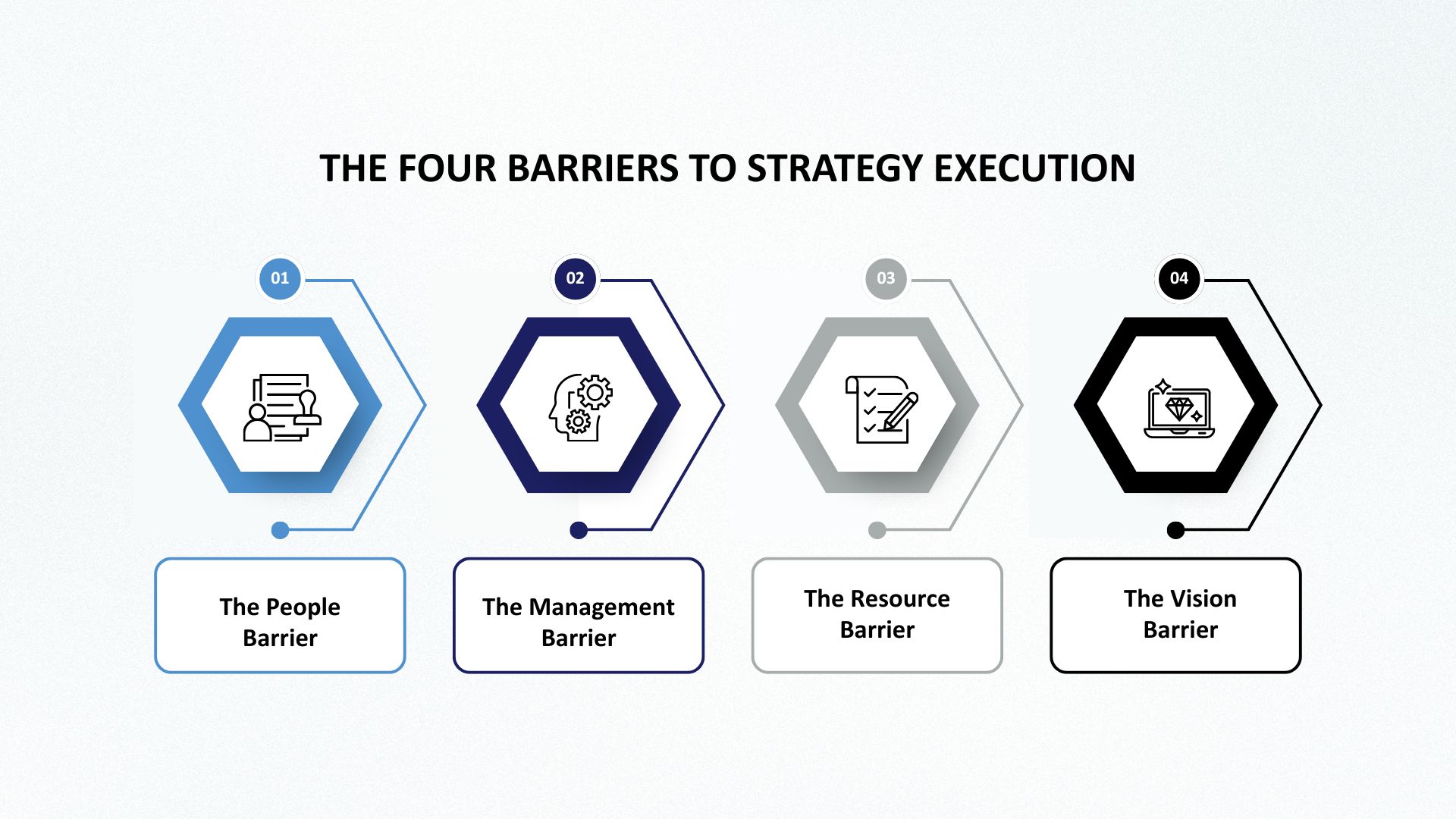
Common barriers to execution include:

* The people barrier – only 25% of managers have incentives linked to strategy.
* The management barrier – 85% of executive teams spend less than one hour per month discussing strategy.
* The resource barrier – 60% of organisations don’t link their budgets to strategy.
* The vision barrier – just 5% of the workforce understands the strategy.
 

Introducing the balanced scorecard

At its core, the Balanced Scorecard is a framework that helps organisations translate strategy into operational objectives. It moves beyond financial metrics alone, creating a holistic view of performance across four key perspectives:
  1. 1. Financial – to satisfy shareholders, what financial objectives must we achieve?
  2. 2. Customer – to achieve our financial objectives, what customer needs must we serve?
  3. 3. Internal processes – to satisfy our customers and shareholders, in which processes must we excel?
  4. 4. Learning & growth – to achieve our goals, how must our organisation learn, innovate, and improve?

Cause and effect: the power of linkages

One of the most powerful features of the Balanced Scorecard is its recognition of cause-and-effect relationships.

For example:

* Investing in Learning & Growth (skills, tools, systems)
* Improves Internal Processes (delivery, innovation, efficiency)
* Which increases Customer Value (quality, reliability, satisfaction)
* Leading to stronger Financial Results

The six steps to implementing a Balanced Scorecard

The Balanced Scorecard isn’t just a reporting tool. It’s a structured process for turning strategy into action. Here’s how.
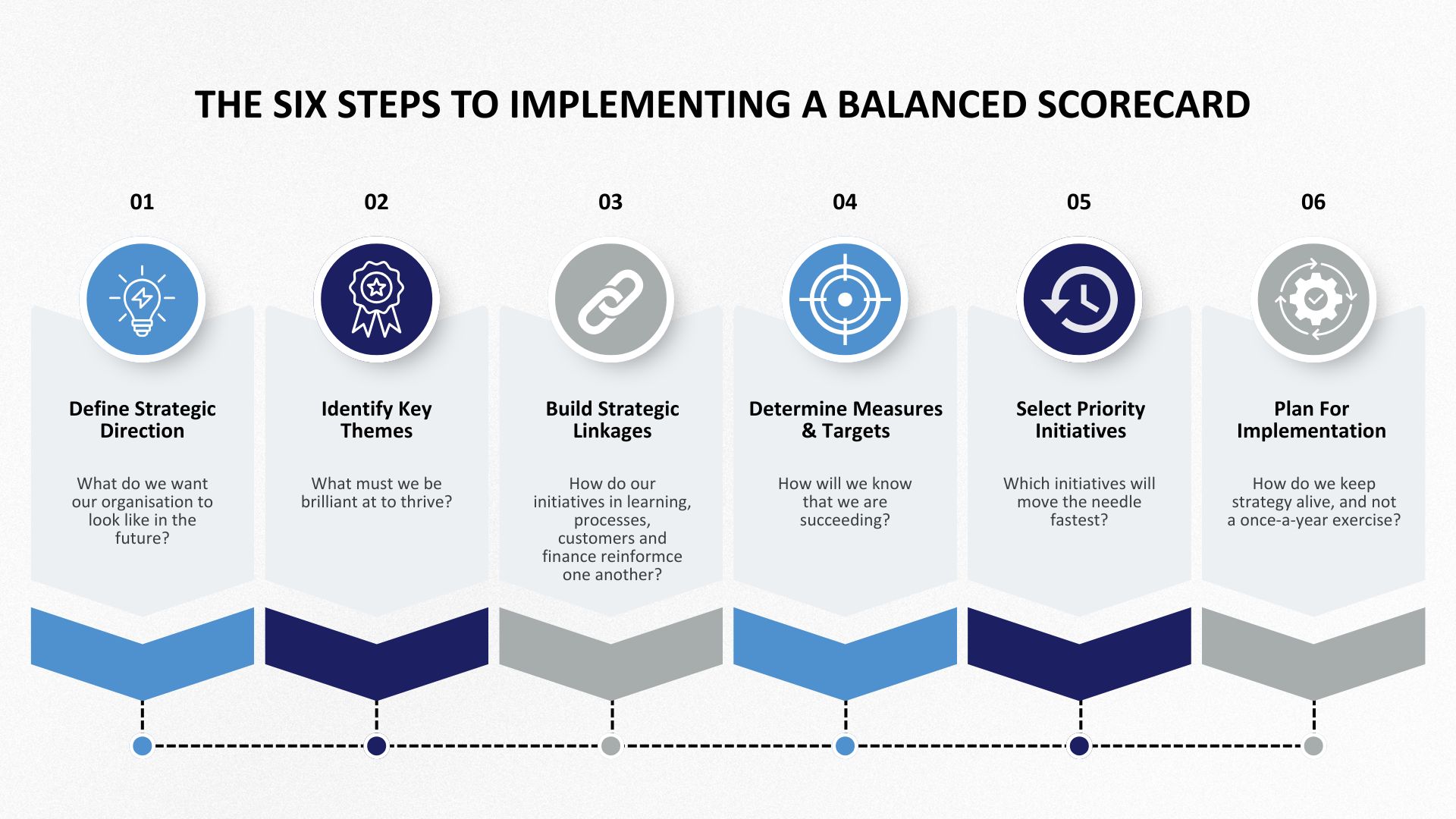
1. Define strategic destination

Leaders must articulate a clear vision of what the organisation should look like in three to five years. This involves scanning competitors, markets, customer demands, and employee aspirations.

Key Question: What do we want our organisation to look like in the future?

2. Identify key themes

Pinpoint the strategic priorities that will drive success. These could include acquiring and retaining high-value customers, increasing revenue per customer, or reducing costs.

Key Question: What must we be brilliant at to thrive?

3. Build strategic linkages

Create a strategy map showing how objectives across the four perspectives connect. This clarifies how individual actions contribute to the bigger picture.

Key Question: How do our initiatives in learning, processes, customers, and finance reinforce one another?

4. Determine measures and targets

Decide how success will be measured. Use both lag measures (e.g., revenue growth, customer retention) and lead measures (e.g., time spent with customers, staff competencies).

Key Question: How will we know if we’re succeeding?

5. Select priority initiatives

Not every project is strategic. Prioritise initiatives that will close performance gaps and deliver the biggest impact. Look for quick wins and initiatives with strong knock-on effects.

Key Question: Which initiatives will move the needle fastest?

6. Plan for implementation

Turn strategy into daily action. Assign accountability, set milestones, establish reporting processes, and align leadership behaviour. Importantly, hold the first review meeting within 60 days.

Key Question: How do we keep strategy alive, not a once-a-year exercise?

Leadership: the missing ingredient

No framework works without leadership. Leaders must:

* Own the process and monitor progress
* Lead their teams with energy, communication, and motivation
* Cascade the strategy so everyone understands their role

Without energetic leadership, strategy remains a plan on paper.

Becoming a strategy-focused organisation

A successful Balanced Scorecard process can transform an organisation into what Kaplan and Norton describe as a strategy-focused organisation. Such companies:

* Mobilise change through strong executive leadership
* Make strategy a continual process, not a one-off event
* Align the organisation around the strategy
* Translate strategy into everyday operations
* Make strategy everyone’s job

The Balanced Scorecard provides more than performance measurement as it offers a blueprint for execution. By combining vision with operational detail, and linking actions to outcomes, it ensures strategy doesn’t just sit on a shelf but drives meaningful results.

For leaders committed to bridging the gap between formulating and executing strategy, the Balanced Scorecard is an indispensable tool.

If any of this resonates with you then please get in touch and we’d love to have a chat.

How do I create my own care company?

For many entrepreneurs and health professionals, starting your own health or social care business is an exciting step. Whether that be delivering personal care on a domiciliary basis to help people live independently in their own homes or supported living for those individuals with learning disabilities to live in supported accommodation, is a is deeply rewarding concept.

But where do you start? And what do you need to get right from the outset?

Well, here’s a clear, step-by-step guide to help you turn your vision into a thriving, compliant business.

1. Understand what delivering both of these care categories involves

Domiciliary personal care (sometimes called home care) covers a wide range of services, from helping people with washing, dressing, and meals, to providing medication support and companionship. A supported living service enables individuals with learning disabilities to live as independently as possible either, in their own homes, or in supported accommodation with personalised support tailored to their needs.

Before you launch, you need to define your service offering. Here are some questions to ask yourself:

* Will you focus solely on personal care (regulated by the Care Quality Commission)?
* Will you include other services like supported living for those people with learning disabilities, live-in care, palliative care, or respite care?

Being clear about what you’ll deliver helps shape your business model and registration process.

2. Develop a robust business plan

Like any business, a home care company needs a strong plan.
In our experience, this should cover:
* Your vision and mission – what impact do you want to make?
* Your value proposition – emphasis on the features and benefits
* Your team – management structure, fit and proper personnel
* Target market – who are your clients? Elderly people? Adults with learning disabilities? Or both?
* Services and pricing – how will you structure your care packages and fees?
* Staffing requirements – how many carers do you need to start?
* Financial planning – how will you fund start-up costs and manage cash flow?
This should not be seen as just a tick-box exercise. A well-written business plan helps you secure funding and stay focused on your goals.

3. Register with the Care Quality Commission (CQC)

If you’re providing personal care combined with supported living  in England, registration with the CQC is mandatory.

You’ll need to:
* Apply for the right regulated activity (typically “personal care”).
* Appoint a Registered Manager or Nominated Individual who meets the CQC’s “fit and proper person” criteria.
* Prepare detailed policies and procedures covering safeguarding, infection control, complaints handling, training, and more.
* Show you meet the CQC’s fundamental standards for safe, effective, caring, responsive and well led compassionate care.

Don’t underestimate this process as it takes time and requires clear documentation. Getting professional support can make a big difference.

4. Build the right team

Your staff are the heart and soul of your care business.

You must recruit carers who are not only qualified but also share your values of compassion, dignity, and respect.

You’ll also need:
* A Registered Manager (if you’re not taking this role yourself).
* A support team to handle scheduling, payroll, and compliance.

Investing in your people with thorough training, both for new starters and ongoing professional development, and the quality of your team will set you apart you’re your competitors.

5. Set up your systems

Efficient systems save time, increase operational efficiency and most importantly and reduce stress.

You’ll need to consider:
* Care planning software – to manage visits, keep records, and track outcomes.
* HR and payroll systems – to stay on top of compliance and payments.
* Policies and procedures – for everything from data protection to whistleblowing.

These systems aren’t just for convenience but are vital for compliance and quality care delivery.

6. Secure funding

Creating a care company business model isn’t cheap. Costs include CQC service user fees, insurance, staff recruitment, training, and technology.

There are funding options which may include:
* Government-backed Start-Up Loans.
* Grants from local authorities or social enterprise funds.
* Social investment if you have a strong community impact model.

Getting professional support can make a big difference during this critical phase.

7. Build your brand and market your services

Once your foundations are in place, it’s time to attract clients.

Here are some vital things that you must do:
* Create a strong brand identity – a name, logo, design style and messaging that communicates trust and professionalism, but also importantly captures the essence of your vision and values.
* Build a website that explains your services clearly and helps people contact you easily.
* Register and optimise your Google Business Profile – essential for local search visibility.
* Use social media (especially LinkedIn and Facebook) to build connections with referral partners and families.

Word-of-mouth and partnerships with stakeholders such as GPs, hospitals, and local authorities will also be key to growing your client base.

8. Stay compliant and continuously improve

Once you’re up and running, your focus must be on delivering safe, high-quality care.

You will need to:
* Stay up to date with CQC requirements.
* Regularly review your policies, staff training, and client feedback.
* Be proactive in addressing issues before they escalate.

Strong governance builds trust, with regulators, clients, and your community.

Final Thoughts

Whatever the shape, creating a care business takes planning, compliance, and resilience. But with the right strategy, team, and support, you can create a business that truly changes lives.

We’ve helped many health and social care entrepreneurs turn their ideas into thriving businesses. If you’re ready to take the first step, with a hands on service on your behalf, we can support you through every stage, from shaping your vision to CQC registration and beyond.

What to consider when applying to the Care Quality Commission (CQC)

If you’re planning to start a health or social care business in England, whether a domiciliary care agency, supported living service, or care home, one of the first and most important steps is registering with the Care Quality Commission (CQC).

CQC registration is a legal requirement for most types of care services, and it exists to ensure that providers meet key standards for safety, effectiveness, responsiveness, and compassion.

But for many new business start-ups in the health and social care sector, the process can feel overwhelming.

In this guide, we break down the essential things you need to consider before and during your CQC application. Preparing properly now can save you time, stress, and costly mistakes later.

1. Choose the Right Regulated Activity

The CQC doesn’t register you based on your business name, but on the specific regulated activities you intend to carry out.

These are legal definitions of care categories, such as:

• Personal care (support with Activities of Daily Living (ADL), for example, washing dressing and meal preparation)
• Treatment of disease, disorder or injury
• Nursing care
• Accommodation for people who require nursing or personal care
• Diagnostic and screening procedures
• Supported living for individuals suffering from learning disabilities

Each activity comes with its own requirements and expectations. It’s vital to understand which regulated activities apply to your service and to apply for the correct ones.

Applying for the wrong activity, or missing one entirely, could result in delays or even legal non-compliance.

TIP: Review the full list of regulated activities on the CQC website and seek advice if you’re unsure.

2. Appoint a suitable Registered Manager and a Nominated Individual

Most CQC-registered services must have a Registered Manager and Nominated Individual (RM & NI) and these are named individuals. The RM is responsible for the day-to-day running of the service and ensuring quality standards are met. The NI is responsible for the supervision of how the regulated activity is managed.

These individuals must:
• Have appropriate qualifications and experience
• Pass DBS checks
• Show strong leadership and management skills
• Be involved in the delivery of care, not just administration

In many start-ups, the business owner themselves, providing they are qualified health professionals, can be appointed as the Registered Manager/Nominated Individual. If that’s your plan, be prepared to demonstrate that your management structure can meet the required fundamental standards and compliance expectations of the CQC.

TIP: Make sure your CV, training certificates, DBS certificate and references are all up to date and included in your application.

3. Prepare detailed policies and procedures

The CQC will want to see how your service will operate, and that means providing comprehensive policies and procedures that demonstrate your approach to safety, governance, and care quality.

These policies should include:
• Safeguarding vulnerable adults and children
• Infection prevention and control
• Complaints handling
• Consent
• Data Protection
• Good Governance
• Record-keeping and confidentiality
• Recruitment, supervision and training of staff
• Risk assessment and emergency planning
• Medicines management (if applicable)
• Equality, diversity and inclusion

It’s not enough to simply have policies as you must also be able to show how you’ll implement, update and monitor them. This is where many applications fall short.

TIP: Tailor your policies to your specific service. Off-the-shelf documents may not meet the CQC’s expectations.

4. Understand the CQC’s fundamental standards

Before you apply, take time to read and understand the Fundamental Standards of Care, the core expectations that all registered providers must meet. These form the legal basis of CQC inspections and judgments.

For example:
• Person-centred care: services must be tailored to individual needs
• Dignity and respect: every person must be treated with compassion and fairness
• Consent: people must agree to the care they receive
• Safety: care must not put people at risk
• Staff competence: staff must be suitably skilled, trained, and supported
• Governance and accountability: you must be able to show leadership and responsibility

TIP: Use the standards as a checklist when preparing your application and supporting documents.

5. Submit a strong, complete application

Your CQC application is submitted either by email with attachments or online through the CQC Provider Portal. It must include:

• Information about your business structure
• Details of your proposed services and location(s)
• Your chosen regulated activities
• Provider application
• Registered Manager application
• Policies and procedures
• A Statement of Purpose
• DBS checks for directors and the Registered Manager
• References and supporting qualifications
• Financial viability statements
• Business Plan
• Cash Flow profit / loss calculations

Incomplete or poorly explained applications are the number one reason for delays. Take your time, check everything thoroughly, and ask someone else to review it before submitting.

TIP: Don’t rush. A detailed, well-structured application shows the CQC you take quality and compliance seriously.

6. Be prepared for inspection after registration

Once your application is approved, the CQC can inspect your service at any time, and you won’t always get much notice.

In essence, inspections are based on the CQC’s five key questions:
1. Is your service safe?
2. Is it effective?
3. Is it caring?
4. Is it responsive to people’s needs?
5. Is it well-led?

The best way to prepare is to build a strong foundation from the start, with clear processes, good record-keeping, and a team that shares your vision for quality care.

TIP: Keep your policies and evidence up to date and regularly review your service through audits or mock inspections.

Preparation is everything

Applying for CQC registration is a big step, but it doesn’t have to be overwhelming. With careful planning, professional advice, and the right support, you can build a compliant, well-run service that delivers real value to your community.

At Strategic Growth Solutions, we help you with whole process with hands on documentation completion. We help with the following:
• Understanding which regulated activities apply to you
• Preparing your policies, documents, and CQC application
• Building a sustainable business plan and financial forecast
• Getting ready for inspection and long-term compliance

We’ve supported dozens of care entrepreneurs through this journey, and we’d love to help you too. We’ll work with you face-to-face so you don’t need to worry about any aspect of the application procedure.

Case Study – Strategy & Organisation

Based in Macclesfield, Cheshire, Axon delivers business aligned end-to-end cloud computing and communications solutions that empower its clients to achieve more. The company is a recognised expert in Microsoft technologies and builds trusted and secure environments to mitigate risk, increase business performance and deliver a clear return on investment. In 2016 the company identified the need to undertake an overhaul of its organisational structure to improve the customer service experience.

The Challenge

  • The board identified that the strategy of the company was not supporting the growth vision of the business.
  • This was becoming evident as the company identified the need to change to avoid the risk of not delivering a first class service to its existing client base.
  • It was thought that the lack of clearly defined service offerings and roles within a complex organisational structure were contributing factors.
  • The desired outcome was to design and implement service offerings according to the competences of the technical managers and engineers and the sales and commercial leaders, in order to deliver the best possible customer experience and to support future growth.

The Solution

  • Strategic Growth Solutions was commissioned to work with the company and immediately undertook strategic audit meetings, including sessions to map the existing management structure.
  • It quickly became evident that service offerings, roles and responsibilities were complex and difficult to manage and were causing misunderstandings internally and if not addressed would create client confusion, thus requiring action to be taken.
  • A further key consideration was to improve a stronger communication culture with clear lines of accountability and reporting.
  • Re-mapping of the entire management structure and service offerings was undertaken to separate each department and redefine job roles and areas of responsibility, based on the key competences of the business and its people.

Delivering Positive Outcomes

  • A new organisational structure was implemented that clearly separated the strategic responsibilities of the board from tactical operations and saw the appointment of an operations manager.
  • Clear lines of reporting and responsibilities were implemented with six business unit leaders created below the operations manager, including sales, marketing, finance, cloud development, cloud services and cloud support.
  • The new structure now supports the key drivers in the business and provides a strong, motivated and empowered team unit.
  • The core objective to implement a structure that was both simple and uncomplicated, while creating a sustainable operation for the future, was achieved.